This post is also available in: Indonesia (Indonesian)
Ordering an auto part online requires more than matching a vehicle’s year, make, and model. The same vehicle line can include different engines, transmissions, trim levels, production dates, and factory configurations. A part that appears suitable in a general catalog may therefore be incompatible with a specific vehicle.
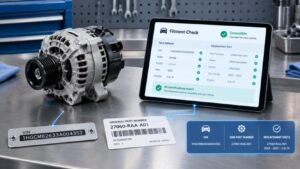
The safest approach is to verify the vehicle’s identification data, locate the original equipment manufacturer (OEM) part number, cross-reference approved replacement numbers, and confirm the seller’s fitment information before purchase. This process reduces the risk of receiving an incorrect component, paying for return shipping, or installing a part that does not match the vehicle.
Why basic vehicle details are not enough
Online parts catalogs commonly organize products by year, make, and model. Those fields are useful for narrowing a search, but they may not identify the exact factory configuration. A single model can be sold with multiple engine codes, body styles, brake systems, suspension setups, or trim-specific components.
Production changes can also occur during a model year. Two vehicles with the same advertised year and model name may require different components because of a mid-year revision or a different build date. Trim names can create a similar problem when a component varies between standard and higher-specification versions.
Ordering from broad vehicle information alone can lead to several risks:
- The replacement part may not physically fit.
- An electrical connector, mounting point, or dimension may differ.
- The part may be intended for a different engine or braking system.
- The component may need to be returned after delivery.
- Installing an unsuitable component can create mechanical or safety concerns.
A systematic fitment check is therefore more reliable than relying on a product title or a general catalog filter.
Use the VIN to identify the vehicle configuration
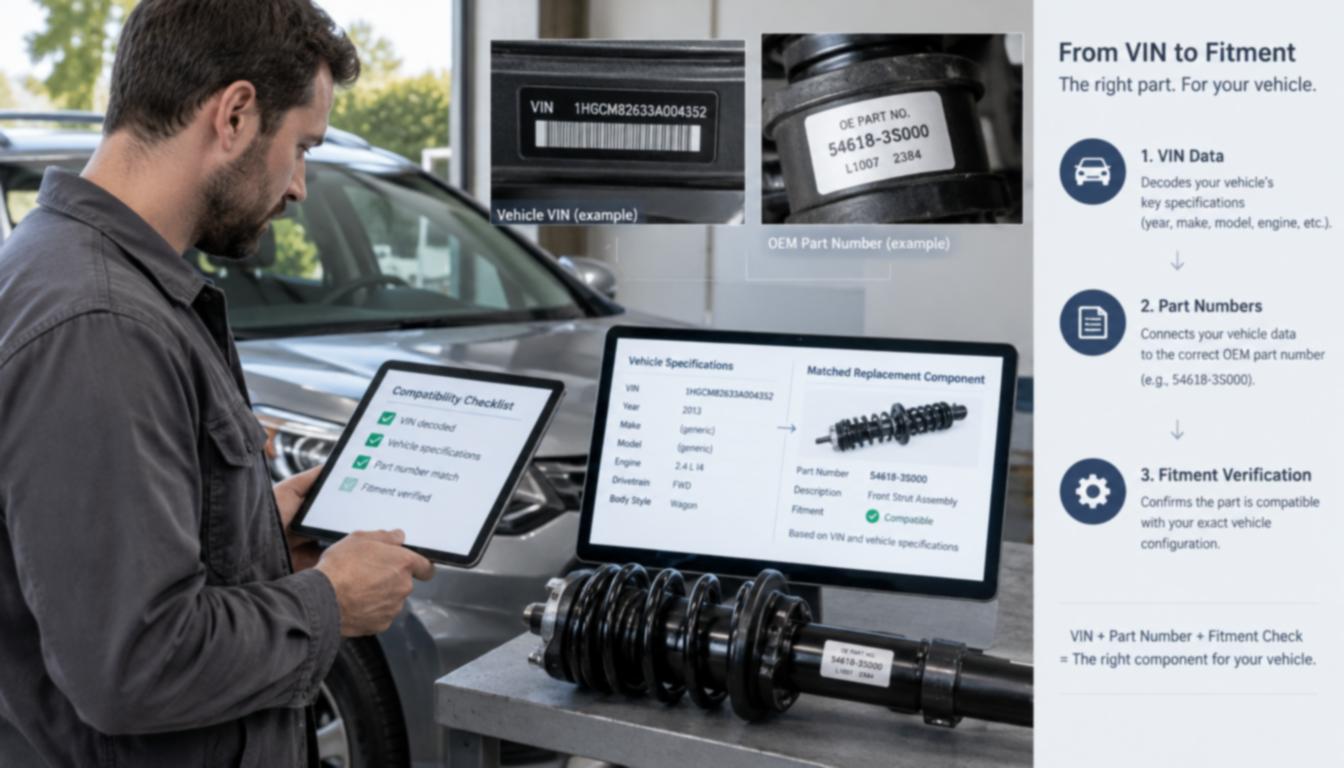
The vehicle identification number, or VIN, is the primary reference for confirming a vehicle’s identity and factory configuration. It is a 17-character code that can encode details such as model year, body style, and engine type. Europarts360’s guide to finding the right part using a VIN also identifies the VIN as the most accurate method for confirming vehicle specifications before selecting a replacement component.
The VIN is usually located on the driver’s side of the dashboard near the windshield, on the driver’s side door frame, and in vehicle registration or insurance documents. The exact location can vary by vehicle, so the owner’s documentation may provide additional guidance.
For an online part search, the relevant information should be recorded exactly as shown. A single incorrect character can identify a different vehicle or prevent a catalog from returning useful results. The VIN should be compared against the vehicle documents before it is entered into a parts database.
Check the engine code and submodel
The VIN may identify the vehicle’s broad factory configuration, but some fitment checks also require an engine code, transmission type, drivetrain, or submodel. These details can affect the correct dimensions, mounting arrangement, sensor configuration, and operating requirements of a replacement part.
Useful information may appear on the vehicle emissions label, the original service documentation, registration records, or the manufacturer’s parts catalog. The exact source depends on the vehicle and component. When a catalog requests an engine code or submodel, that field should not be left to an assumption based on appearance or engine size alone.
Consider the production date
A standard model year does not always identify the complete production period. If a part catalog lists a cutoff date, build range, or production change, the vehicle’s exact production date becomes important. The date may appear on a vehicle identification label, manufacturer documentation, or a parts database linked to the VIN.
When a component has separate listings before and after a production change, the production date should be treated as a required fitment detail rather than an optional specification.
Understand OEM and aftermarket part numbers
An OEM part number is the identifier assigned to a component by the vehicle manufacturer or the original equipment supplier. It provides a more precise reference than a general description such as “front sensor” or “brake pad.” The number may be printed on packaging, stamped or molded into the component, or listed in service and parts documentation.
The original part number can be especially useful when the vehicle’s online catalog produces several visually similar results. It gives the search a specific identifier that can be checked against manufacturer catalogs, professional interchange systems, and reputable aftermarket listings.
Separate the original number from the replacement number
Aftermarket manufacturers may assign their own part numbers to components designed to replace an OEM part. Those numbers are not automatically interchangeable merely because the product description uses similar language. A replacement number should be linked to the original OEM number through a documented interchange or cross-reference listing.
Cross-referencing should confirm more than a general product category. The listing should connect the replacement to the precise OEM number and, where available, specify the relevant engine, submodel, production range, or vehicle application.
Use interchange catalogs carefully
Interchange catalogs can help identify alternatives, but their results still require validation. A catalog may list a component as interchangeable because it matches one dimension or application category while excluding a vehicle variation that matters for the specific installation.
Before accepting an interchange result, the fitment record should be checked for:
- The exact OEM part number.
- Vehicle year, make, and model.
- Engine code and drivetrain, when relevant.
- Submodel or trim restrictions.
- Production dates or serial-number ranges.
- Position, such as front, rear, left, or right.
- Connector type, mounting design, dimensions, or other listed specifications.
A visual match is useful as a secondary check, but it should not replace the part-number and vehicle-configuration checks.
Verify the seller’s fitment information
Seller fitment notes should be treated as another source of verification rather than the sole basis for a purchase. The vehicle details entered into the listing should match the VIN-derived configuration, OEM number, and any relevant production restrictions.
Part listings can contain broad compatibility language, especially when a product fits several vehicle applications. A listing that says a component fits a particular model may still contain exclusions for engine type, body style, trim, production date, or position. Those exclusions should be reviewed before the item is added to an order.
Product photos can help identify connector shapes, mounting points, and physical differences, but photographs may show a representative item rather than the exact unit that will be shipped. The catalog number and documented application remain more reliable references.
Use digital tools to simplify compatibility checks
Fitment verification involves several connected details: VIN data, engine codes, production dates, OEM numbers, interchange records, and seller notes. A digital shopping assistant can help organize those requirements and translate technical specifications into clearer product-selection guidance.
Pick it Quick’s Interactive AI Shopping Assistant uses natural language processing for user queries and automated, context-aware product curation. In a relevant automotive shopping scenario, a DIY car owner can provide the vehicle information and the required component, then use the resulting guidance as a structured starting point for checking available products.
Such a tool can reduce research time by helping connect a plain-language request with technical product information. It should still be used alongside the vehicle VIN, part-number records, and seller fitment documentation. An AI recommendation can support the verification process, but it does not remove the need to confirm the final application details before purchase.
For broader context on automated vehicle-component selection, the related article Automated part matching in modern automotive retail discusses how digital retail platforms can support the matching process.
Complete the final fitment checklist
Before committing to an online purchase, the following information should align:
- The VIN matches the vehicle documents.
- The vehicle’s engine code, transmission, drivetrain, submodel, or trim has been confirmed when relevant.
- The production date falls within the listed fitment range.
- The OEM part number matches the required component.
- The aftermarket number is connected to the OEM number through a documented cross-reference.
- The installation position and component variation are correct.
- The seller’s fitment notes do not list an exclusion for the vehicle configuration.
- The return and warranty conditions have been reviewed in case the catalog information is incomplete.
If any of these checks conflict, the purchase should be paused until the discrepancy is resolved through a parts catalog, service record, manufacturer resource, or qualified automotive professional.
Make compatibility verification part of the buying process
Checking auto part compatibility is a data-matching task rather than a simple product search. The VIN establishes the vehicle configuration, the OEM part number identifies the original component, and interchange records help connect that component to suitable aftermarket alternatives. Production dates, engine codes, submodels, and seller exclusions provide additional safeguards when a vehicle has multiple configurations.
DIY car owners who want help organizing those details can use Pick it Quick’s digital concierge chat to translate a parts request into clear, actionable compatibility checks and curated product options. The final decision should remain based on verified vehicle and part information, with the assistant serving as a tool for reducing research effort and improving clarity.