
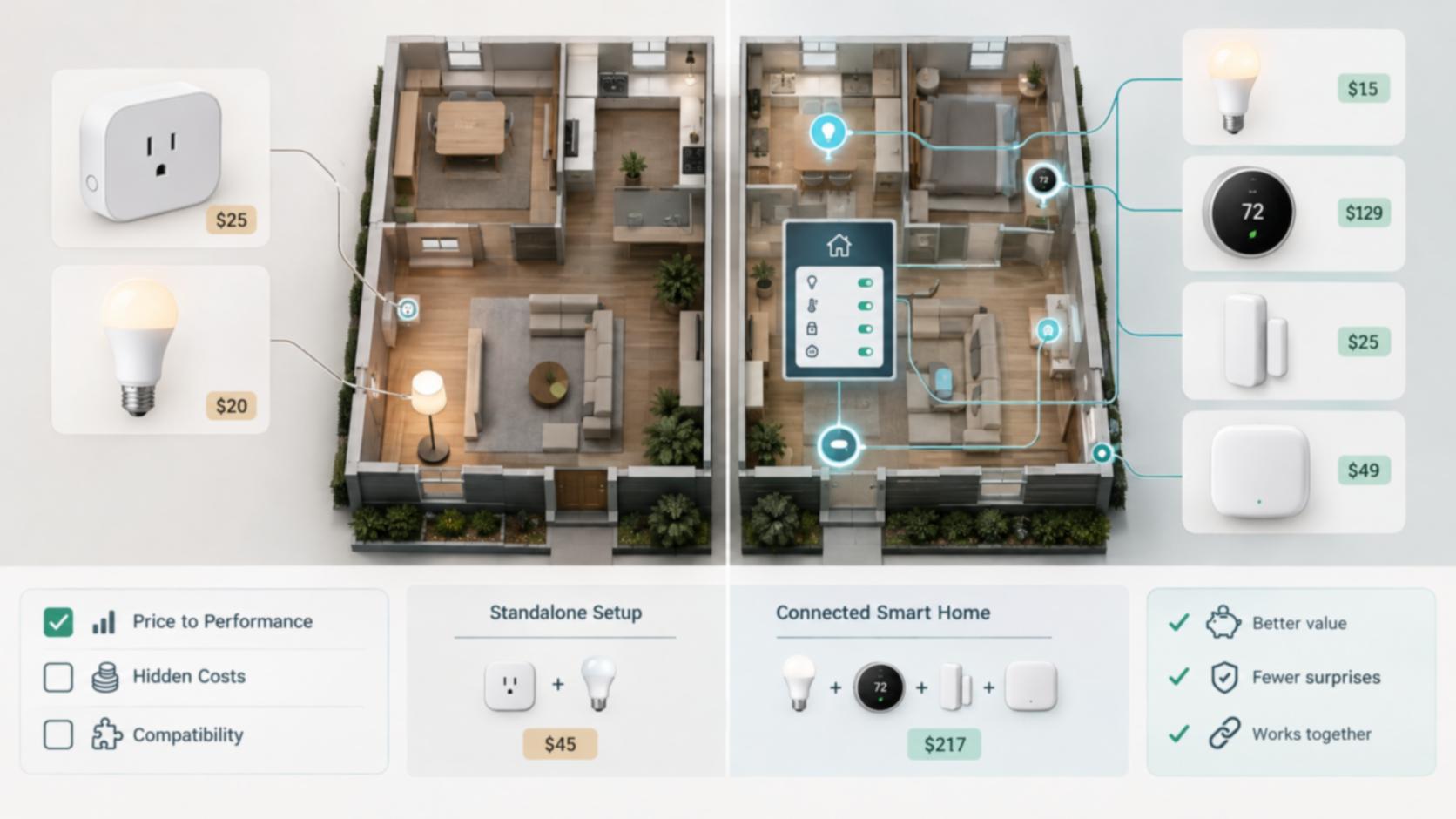
Premium smart home ecosystems are most useful when a household needs several devices to work together through shared routines, controls, and alerts. Budget standalone devices are often sufficient when automation is limited to isolated tasks, such as controlling one light, plug, or appliance on a schedule.
The central distinction is not simply device price. It is the level of coordination a household requires, the ongoing costs it accepts, and the degree to which it is willing to depend on one ecosystem. A higher initial price can be justified when connected devices provide useful daily automation. It is less justified when the same result can be achieved with a small number of independent devices.
The cost divide in smart home technology
A budget smart home setup generally consists of individual devices that address specific tasks. These may include smart plugs, bulbs, sensors, or switches that can be controlled through their own apps or a basic voice-control arrangement. Each device can provide a practical function without requiring a broad home automation plan.
A premium smart home ecosystem is designed around coordinated control. It may include a central hub, compatible sensors, cameras, locks, lighting, climate controls, and automation routines that connect multiple devices. The higher cost can reflect hardware, setup requirements, expanded controls, and access to ecosystem-specific features.
For households seeking isolated automation, the basic approach is often adequate. A smart plug that schedules a lamp or an individual sensor that sends an alert does not necessarily require a broad ecosystem. For households that want devices to respond to one another, a coordinated system can provide more practical value. For example, a household might want a sensor event to trigger lighting, an alert, and a change in another device’s settings through a single routine.
The question is therefore not whether expensive smart home devices are inherently better. It is whether coordinated automation solves a household need that standalone products cannot address as simply.
Evaluating price-to-performance trade-offs
Price-to-performance in smart home technology should be measured against the automation outcome, not the number of features listed on a product page. A lower-cost device can offer strong value when it performs one required function consistently and does not create unnecessary setup or maintenance work.
A higher-tier system can offer stronger value when several devices need to operate as one system. Its advantage is usually not that each individual device performs a completely different basic task. Rather, it is the ability to organize controls, routines, notifications, and compatible devices within a shared configuration.
Standalone devices and isolated tasks
Budget devices are a practical fit when the household’s needs are narrow and independent. Relevant situations may include:
- Adding scheduled control to one or two lamps or appliances.
- Using a single sensor or smart switch for a defined area.
- Testing whether smart home automation is useful before making a broader investment.
- Keeping the setup simple enough that each device can be managed independently.
In these situations, paying for a hub, broader compatibility, or advanced routines may add cost without materially improving the outcome. The device’s value depends on whether its individual controls meet the intended use.
Integrated systems and coordinated automation
Premium ecosystems become more relevant when a household needs connected actions across rooms, device types, or household members. A more integrated configuration can centralize device management and support routines that combine several actions under one trigger, schedule, or command.
For example, a household with lighting, entry sensors, climate controls, and security-related devices may place value on coordinated settings and a consistent control experience. In that case, the initial investment should be evaluated against the time and complexity saved by managing a shared system rather than several separate products.
Reliability and responsiveness should also be assessed at the system level. Shoppers should examine how devices connect, what happens when an internet connection is unavailable, whether a hub is involved, and whether critical functions remain accessible through local controls. These details can matter more than a broad description such as “advanced” or “premium.”
Hidden costs: subscriptions, hubs, and ecosystem lock-in
The purchase price is only one part of the cost of a smart home setup. A complete comparison should identify recurring fees, additional hardware, replacement needs, and the cost of changing systems later.
Subscriptions and feature tiers
Some smart home products offer optional or required subscriptions for functions such as extended cloud storage, advanced security notifications, or additional service features. These charges can change the long-term cost of a device substantially, particularly when several products are added to the household.
Before purchasing, shoppers should determine which functions work without a subscription, which features depend on recurring payment, and whether the household will continue to need those features after the initial setup. A lower-priced device with a recurring fee may cost more over time than a higher-priced option with fewer ongoing charges.
Hubs and proprietary requirements
Some ecosystems require a dedicated hub or other proprietary component to enable full functionality. A hub can be useful when it provides centralized coordination, but it should be treated as part of the system’s true starting cost rather than as an optional accessory.
Compatibility also requires careful review. Ecosystem lock-in occurs when devices, routines, or management tools are closely tied to one provider’s system, making future changes more complicated or more expensive. This is not automatically a disadvantage; a unified environment may be appropriate for a household that values coordinated operation. It becomes a concern when a buyer expects to mix products freely or replace only one part of the system later.
Maintenance should be included in the calculation as well. This includes updating apps, managing device access, replacing batteries where applicable, reviewing subscriptions, and confirming that the system still supports the household’s intended routines.
Matching investments to household automation needs
An effective purchase decision starts with a clear description of the task the household wants to automate. The appropriate tier follows from that requirement.
Budget standalone devices are generally a reasonable choice when the household needs a small number of independent controls, has no need for multi-device routines, and prefers to limit upfront spending. They can also provide a useful entry point for evaluating whether automation fits daily routines.
A premium ecosystem is more likely to provide tangible value when the household needs several categories of devices to work together, wants centralized management, or expects to expand the setup over time. It may also be appropriate when shared routines, coordinated alerts, and compatibility planning are more important than keeping each individual purchase inexpensive.
Before comparing products, shoppers can define the decision with a short set of criteria:
- The number of devices and rooms included in the intended setup.
- Whether devices must trigger actions in one another.
- Whether a hub, subscription, or proprietary accessory is required.
- Which functions remain available without recurring fees.
- Whether future additions need to work within the same ecosystem.
- How much ongoing management the household is prepared to handle.
These criteria shift the comparison from cheap versus expensive smart home tech to a more useful question: which configuration delivers the required automation without adding unnecessary cost or complexity.
Making a more informed smart home purchase
Smart home purchases can involve compatibility terms, subscription conditions, and technical specifications that are difficult to compare across products. A structured review of the required task, the total cost, and the desired level of integration can reduce the risk of paying for features that do not serve a household need.
For shoppers weighing several options, conversational curation can help reduce online shopping decision fatigue when product choices and specifications become difficult to assess.
Pick it Quick’s digital concierge chat can help shoppers translate technical specifications into actionable comparisons and receive personalized product curation based on a defined budget, existing setup, and intended automation needs.