
This post is also available in: Indonesia (Indonesian)
Buying a replacement vehicle component without confirming its fitment can create avoidable costs and safety concerns. A part that appears similar may differ in mounting points, electrical connectors, dimensions, engine application, or other specifications that determine whether it can function correctly in a particular vehicle.
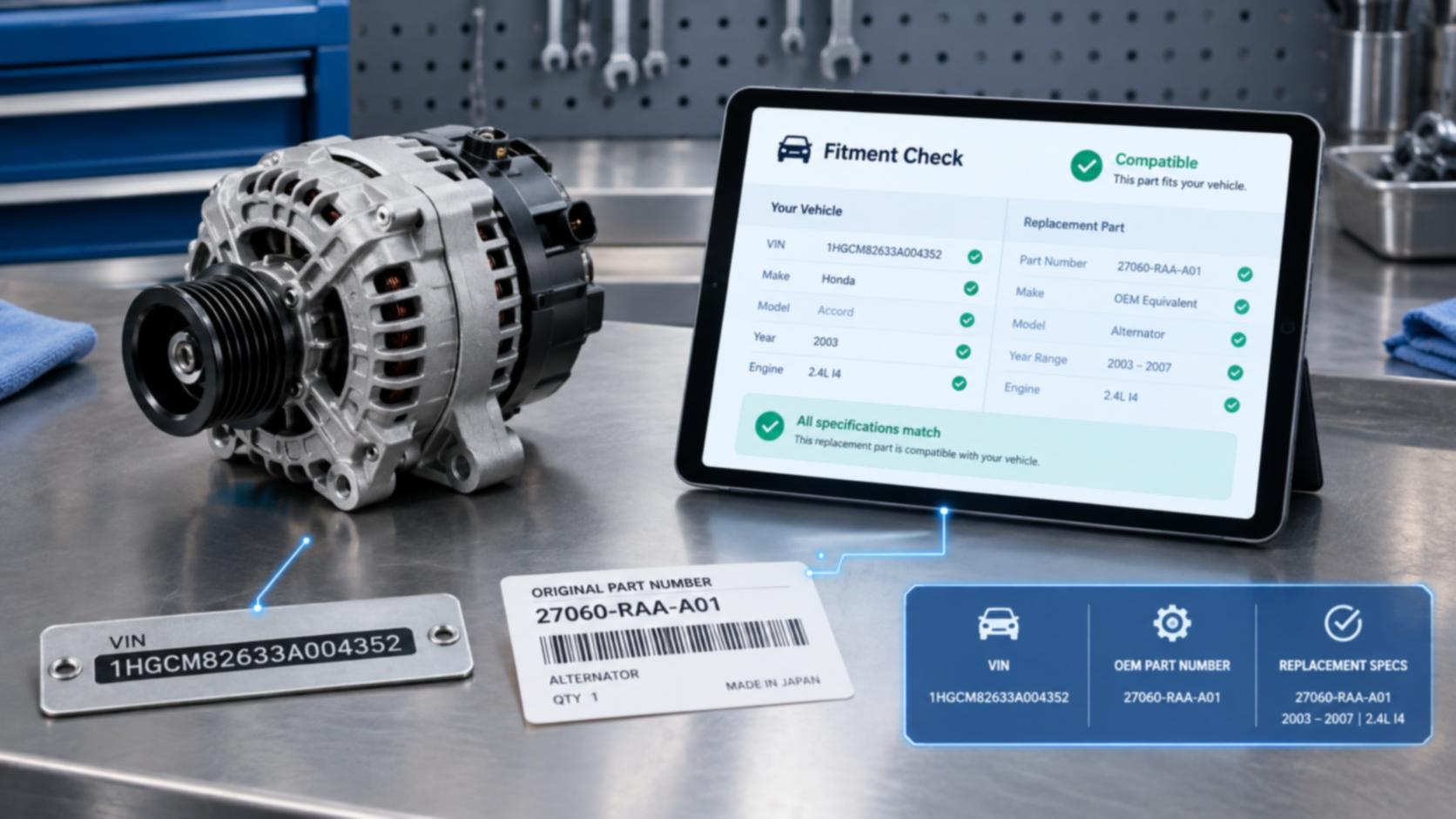
The most reliable approach to car part compatibility begins with the vehicle’s 17-character Vehicle Identification Number (VIN), then compares the original equipment manufacturer (OEM) part number and the replacement part’s published fitment data. These checks should be completed before purchase and repeated against the actual vehicle and component before installation.
Why exact auto part fitment matters
Automotive components are designed for defined vehicle applications, not merely for a broad make, model, and year range. Vehicles sold under the same model name can have different engines, transmissions, brake systems, trim levels, production dates, and factory options. Those differences can affect the correct replacement part.
An incompatible component can lead to a failed installation, return shipping costs, wasted labor, or damage if it is forced into place. For components connected to braking, steering, suspension, electrical, fuel, or engine systems, uncertainty about fitment should be treated as a reason to pause the purchase and obtain additional verification. A listing that says a part fits a vehicle is useful evidence, but it should be evaluated alongside the vehicle’s identifying data and the part’s specifications.
A practical verification record should include:
- The full 17-character VIN
- The vehicle’s make, model, model year, engine, and relevant configuration details
- The OEM number from the original component, where available
- The replacement part number and manufacturer fitment chart
- Key physical and technical specifications, such as dimensions, connector type, mounting pattern, or side of vehicle
Use the VIN to establish the exact vehicle configuration
The VIN is the strongest starting point when asking, “Will this part fit my car?” It identifies an individual vehicle more precisely than a model-year search alone. The number is commonly visible through the windshield on the driver’s side of the dashboard and may also appear on the driver’s side doorjamb. Vehicle documents can provide another reference, but the VIN on the vehicle should be checked for consistency.
The National Highway Traffic Safety Administration explains through its VIN Decoder that a 17-character VIN encodes vehicle information, including manufacturer and plant data. A decoder can help establish a dependable baseline for matching parts, particularly where a model name covers several configurations.
VIN data should be used to confirm the vehicle details requested by a parts catalog or seller. Depending on the component, the relevant fields may include engine designation, drivetrain, body style, production period, and installed equipment. A VIN decoder is a validation tool, not a substitute for reading the replacement part’s stated application.
Check production dates and configuration changes
Production timing deserves particular attention. A vehicle model can receive a mid-year revision, and a catalog may separate applications by build date rather than model year. Where a listing uses a date range, that range should be compared with the vehicle’s documented production information and the original component.
The same caution applies to optional equipment. For example, a replacement part may be listed separately for vehicles with different engine variants, brake packages, connector types, or drive configurations. The relevant listing notes should be read in full rather than relying only on a broad compatibility label.
Locate and cross-reference the OEM part number
An OEM part number is a manufacturer-assigned identifier for a specific original component. When the original part is accessible, its number may be stamped, molded, printed, or shown on an attached label. Service documentation, prior repair records, and an authorized parts catalog may also provide a useful reference.
The number should be copied exactly, including letters, hyphens, suffixes, and revision marks. Small differences can identify a variation intended for another configuration. If a component carries several numbers, the number that identifies the part itself should be distinguished from serial, batch, or supplier codes.
An OEM part and an aftermarket equivalent are not the same category of product. An OEM part is identified by the original manufacturer’s numbering system. An aftermarket part may use its own number while listing an OEM number as a cross-reference. That cross-reference is valuable only when the replacement’s stated application and specifications also match the vehicle.
Compare the part beyond its number
A cross-reference should be treated as the beginning of verification, not its conclusion. The replacement listing should be checked against the original component and vehicle data for the characteristics that affect installation and operation. Depending on the part, those characteristics can include:
- Overall dimensions and mounting-hole locations
- Electrical connector shape, pin count, and connector orientation
- Thread size, hose fitting, or port configuration
- Left- or right-side designation
- Rotor, pulley, belt, or fastener dimensions where applicable
- Included hardware and any exclusions stated by the manufacturer
Manufacturer fitment charts can help organize these comparisons. They should be read for qualifiers such as engine code, transmission type, production date, or package requirement. A chart that identifies a compatible vehicle family but omits a relevant qualifier may require confirmation from the seller, parts manufacturer, or a qualified technician before purchase.
Use digital tools as a second layer of verification
Digital catalogs, VIN lookups, and comparison tools can reduce the work involved in verifying auto part fitment. They can bring together vehicle data, replacement part applications, OEM cross-references, and technical details that might otherwise be reviewed across several listings. Their output should still be checked against the vehicle and the part documentation, especially for safety-critical components.
Interactive shopping assistants can also help translate a technical request into the information needed for a compatibility check. For example, an assistant can prompt for a VIN, the original part number, the vehicle configuration, and the replacement part’s specifications before presenting relevant options. This approach is most useful when the buyer provides complete, accurate information and reviews the stated fitment conditions.
For broader context on this approach, automated part matching in modern automotive retail examines the role of digital systems in organizing compatibility information. A related discussion of artificial intelligence recommendations and amateur automotive maintenance protocols considers how AI-assisted guidance can support informed maintenance decisions.
Apply a final compatibility check before installation
A sound purchasing decision requires agreement across the available evidence: VIN-derived vehicle details, the OEM number or original component, the replacement part number, and the manufacturer’s fitment specifications. If one source conflicts with another, the discrepancy should be resolved before the part is installed.
Before installation, the new component should be visually compared with the original part for matching connectors, mounting points, dimensions, and included hardware. This is not a repair procedure; it is a final fitment safeguard. A part that cannot be confirmed through documentation and direct comparison should not be forced into position.
Pick it Quick’s digital concierge chat provides a real-time interface for organizing technical requirements, comparing stated specifications, and curating relevant product options. DIY car owners can use it to turn VIN details, OEM numbers, and fitment criteria into clearer purchasing information, while retaining responsibility for a final cross-check against the vehicle and component documentation.